A growing share of your visitors are AI agents, not people. On our own site we log around 4,000 AI-crawler requests a day. Here's what agentic readiness means for SaaS, which levers are real versus hype, and how to check where you stand.
Here's the shift, stated plainly: a growing share of the traffic that decides whether your SaaS gets bought is no longer human.
When someone asks ChatGPT to "find me a tool that does X", or lets Perplexity compare three vendors, or points an agentic browser at a shortlist, a machine reads your website on their behalf. It doesn't scroll. It doesn't admire your hero animation. It reads, extracts, compares, and increasingly acts. And almost every SaaS site on the internet was built, pixel by pixel, for a pair of human eyes that may never actually show up.
That gap has a name now. Agentic readiness. And it's worth understanding properly, because most of what's written about it is either panic or hype.
We're not guessing that this is happening. We can see it.
We run Chat Thing, our own AI agent platform, behind Cloudflare. That gives us a slightly unusual vantage point: we can watch the agentic web arrive in the logs.
On a normal day, our properties field around 4,000 requests from AI crawlers, up about ten percent on the period before. It's not one or two familiar names, either. Amazon's bot is the single biggest visitor. Then Google, Baidu, Common Crawl (which feeds a lot of LLM training data), Apple, and OpenAI's GPTBot, with Meta, Bing and ByteDance close behind. The AI-native crawlers are still a minority of the volume, but they're the fastest-growing slice by a distance.
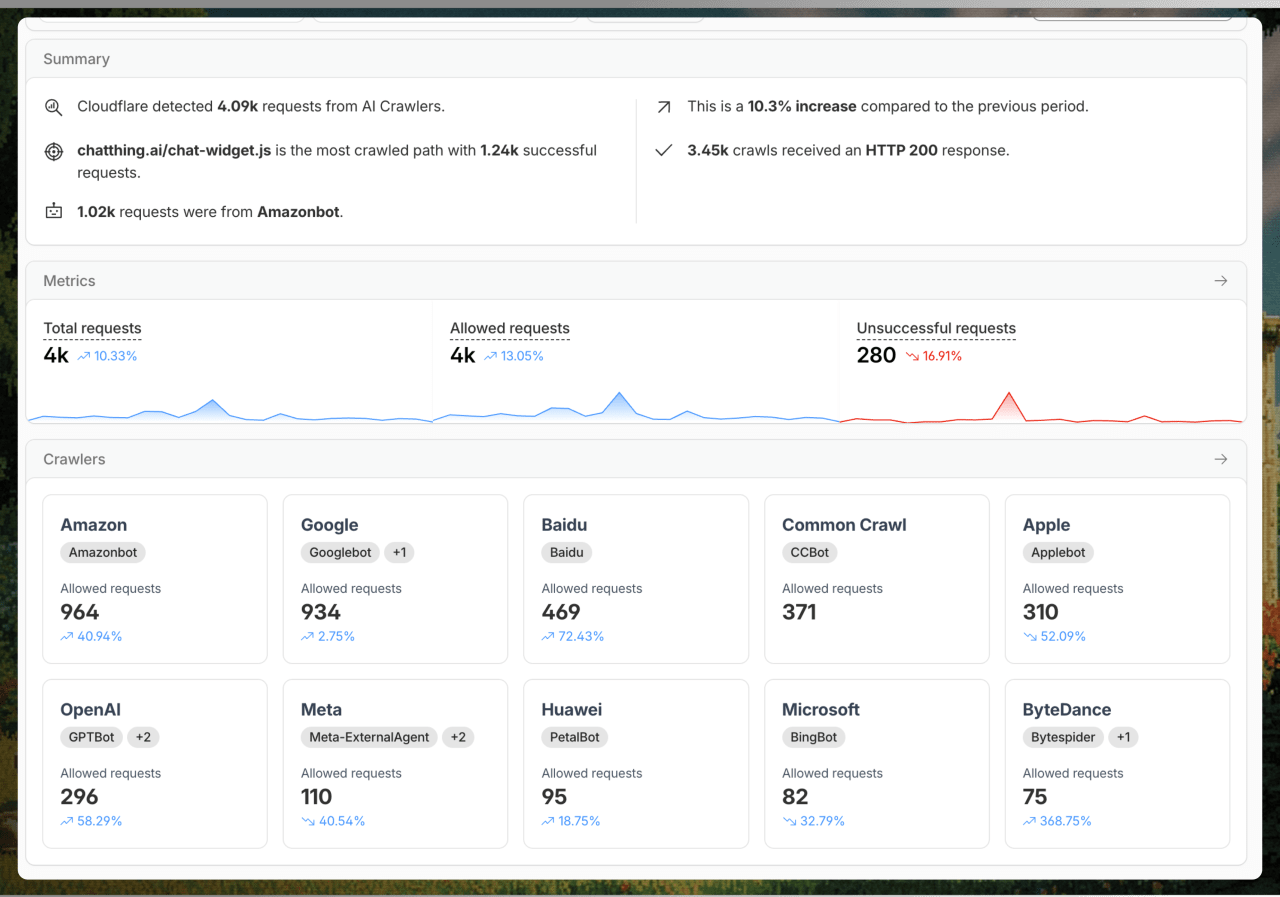 A normal day's AI-crawler traffic on our own site. This is the agentic web, and it is already here.
That's one small platform. Multiply it across the web and the point makes itself: there is now a second audience for your website, it never sees the rendered page a human sees, and hardly anyone has designed for it.
Three questions an agent asks your site
It helps to stop thinking about "AI readiness" as one thing. An agent interacts with your site in three distinct layers, and you can be brilliant at one and hopeless at the next.
Can it reach you? This is access. Can an AI crawler get to your content at all - or is your robots.txt quietly blocking the very citation crawlers you're trying to attract? Here's the one that catches nearly everyone: most of the big AI crawlers, GPTBot and ClaudeBot and PerplexityBot, don't run JavaScript. Only Google really renders. So if your marketing site is a client-side app that paints its content in after hydration, a large slice of the agentic web arrives, sees an empty shell, and leaves. You're invisible to them, and your analytics won't tell you, because they never became a session.
Can it quote you? This is citation. When an answer engine assembles a response, can it lift a clean, self-contained claim from your page and attribute it? This is the layer everyone means when they say "AI SEO", and it's real - but it's less about magic files and more about writing content a machine can actually extract an answer from.
Can it do something? This is transaction, and it's the one almost nobody is auditing. Can an agent take an action on your site - call an API, use a tool, complete a signup or a purchase on a user's behalf? This is where the agentic web is actually heading. The emerging commerce and agent protocols (agent cards, MCP servers, agentic checkout) are early, but "an agent completed the task without a human touching a keyboard" is the direction of travel, and SaaS is squarely in its path.
 Access gets you seen. Citation gets you recommended. Transaction gets you used.
Most SaaS teams have thought about none of the three, because until recently there was no reason to.
Why SaaS feels this first
Two reasons this lands harder on software than on, say, a local plumber.
Your buyers are exactly the people who've moved their research into LLMs. Founders, developers, ops leads - they're asking ChatGPT and Claude "what should I use for X" instead of opening ten tabs. If the models can't read or cleanly cite your product, you're simply not in the consideration set, and you'll never see the deals you didn't make.
And your product is an obvious target for the transaction layer. SaaS runs on APIs and structured actions - the exact surface agents are learning to operate. The companies that make themselves genuinely operable by agents, not just readable, are going to have a strange new advantage.
The honest part: what's real and what's hype
I want to be careful here, because the internet has already filled up with agentic-readiness snake oil, and Pixelhop's whole thing is not doing that.
So, honestly: llms.txt is having a moment, and the evidence for it is thin. When Ahrefs analysed 137,000 sites, 97% of llms.txt files had never been requested by an AI crawler at all, and Google's John Mueller has said none of the AI services actually use it. Schema markup is worth doing, but it's hygiene, not a ranking lever - it won't buy you citations on its own. A lot of the "17 signals you must add today" listicles are padding.
And a generic checklist can't tell a marketing site from a SaaS. The right list for a landing page is not the right list for a SaaS with an MCP server, or a docs site coding agents crawl, or a shop that wants agentic checkout. Advice that ignores what kind of business you are is advice you should distrust. (It's the reason the tool below classifies your site first and re-weights everything around that, marking irrelevant checks as "not applicable" rather than dinging you for them.)
The lever that actually moves the needle is dull and structural: can a crawler that doesn't run JavaScript read your content, and is that content written so a machine can extract a clean answer from it? Get that right and you're ahead of most of your market. Chase the shiny files and you'll feel productive while staying invisible.
If you want the short version of what to actually do: server-render or statically render your key content so it survives a non-JS crawler; check your robots.txt isn't blocking the citation bots; write pages that state self-contained claims a machine can lift; and treat the emerging agent and transaction standards as opportunities to get ahead, not boxes to panic-tick.
Then go a step further than any audit will score you on: make your content trivially easy to hand to an agent. Add a "Copy as markdown" button to your docs and articles. Put an "Open in ChatGPT" or "Ask Claude about this page" action on the pages that matter, so a reader can pass the whole thing to an agent in one click. Serve a clean markdown version to the crawlers that ask for it. None of these are pass-or-fail signals, which is exactly why they're an edge: most of your competitors won't bother.
Why we built this and gave it away
There's a reason a studio like ours is thinking about this out loud, and I'd rather just tell you than pretend it's pure altruism.
We build free tools like this partly because it's genuinely good marketing. A useful thing that people run, share and link to beats another "ultimate guide" every time, and it earns the kind of attention you can't buy. Engineering as marketing, basically. It's the same instinct that had us accidentally growing a whole SEO pipeline instead of writing one more blog post. We think it's one of the most underrated moves a SaaS team can make, and we practise it because we believe it.
Which brings me to the practical next step. We built a free Agent Readiness Checker - a Lighthouse for the agentic web. Point it at your site and it scans how well agents can discover, read and act on it, scored per category and per engine, with no single vanity number and no hype about signals that don't move the needle. And because it's built on Chat Thing, our own platform for building AI agents, you don't just get a report - you can talk to the agent about your results, ask it why a score is what it is, and have it hand you the fixes. It's the same conversational-agent-plus-live-canvas pattern we keep reaching for.
 You don't just read the report. You argue with it, and it hands you the fixes.
If you want the full rundown of what the checker does and what each signal means, we've written that up over on the Chat Thing blog.
The web is being re-read by machines. The SaaS teams that notice early, and fix the dull structural stuff before the shiny stuff, are the ones the agents will end up recommending. Worth knowing which one you are. 🐰

