Building Quantum, the Foremost continuous-improvement product
Foremost teased Quantum at a trade show. Demand was overwhelming. We had three cycles to ship it across 22,745 sites and 2,098 cleaning companies.


'%20fill-opacity='0.26'%20stroke='var(--stroke-0,%20white)'%20stroke-opacity='0.51'/%3e%3cpath%20id='Vector_2'%20fill-rule='evenodd'%20clip-rule='evenodd'%20d='M1420.5%2054.608C1361.5%2062.144%201223.5%20152.685%201105.5%20113.928C987.5%2076.2479%20846%209.5%20727%209.5C609.5%209.50052%20474.5%2054.9719%20355.5%2070.0439C237.5%2086.1925%20119.5%2054.9719%2060.5%2039.8998L0.5%2024.8278V134.99H60.5C119.5%20134.99%20237.5%20134.99%20355.5%20134.99C474.5%20134.99%20592.5%20134.99%20710.5%20134.99C829.5%20134.99%20947.5%20134.99%201065.5%20134.99C1183.5%20134.99%201302.5%20134.99%201361.5%20134.99H1420.5V54.608Z'%20fill='%23faf5f0'/%3e%3c/g%3e%3c/svg%3e)
Foremost teased Quantum at a trade show. Demand was overwhelming. We had three cycles to ship it across 22,745 sites and 2,098 cleaning companies.
Foremost is a UK B2B supplier of cleaning materials to commercial cleaning companies. Their tagline is honest about what they sell: "We Deliver Profitable Growth." Their customers are companies that clean offices, schools, restaurants, surgeries. Their customers' customers are the end clients those buildings belong to.
The commercial cleaning industry has a twin problem. Operatives churn. Clients churn. Each feeds the other. Cleaning is "invisible" when it goes well, visible only when it doesn't. Engagement is low. Recruitment is endless. Margins are thin.
Foremost had spent years quietly collecting the data that could break that loop. CO2 per product. Plastic packaging. Chemical-impact points. Ordering patterns. Employee travel. Product churn. All of it sitting in transactional systems that knew how to bill but didn't know how to advise.
Then they pitched a continuous-improvement system at a trade show, to see if the market wanted it.
We'd launched this incredible concept at a trade show. The response was overwhelming. They wanted it now, if not sooner. But we hadn't got the details sorted. So we had to nail down a spec and get it built as quickly as possible.
Lyndon Penson, Development Director, Foremost
That's when they called us.
The full story
As an AI product studio, our default is to put intelligence inside the product. Quantum was different. The intelligence had to be visible, defensible, and audit-trailable on a system that stores names, pay rates, home addresses, and psychometric profiles. So we put AI in the build, not in the box.
Foremost knew exactly what that meant. They've written their own software in-house for years, so they came in as sophisticated buyers. They didn't bring us in for engineering capacity. They brought us in for product thinking. The design, UX, and polish that a customer-facing system at this level needed sat outside their team's day job.
How do you unlock years of data Foremost already had?
The biggest question across every Figma surface was the same one: where does the data come from? We wrote it down in the discovery doc on page one.
Foremost's legacy systems and Quantum lived in different databases. So Cycle 1 included a legacy sync engine: a regular pull of users, customers, sites, orders, products, and roles into Quantum, keeping the legacy systems authoritative and the scores fresh.
Shareable URLs landed in Cycle 1 too. Every filter, every drill-down, every modal state lives in the URL. Send a teammate a Quantum link and they see exactly what you see. Hit the back button once and you go back one step, not five.
Cycle 1, Foundations (6 weeks). The foundations of the app. A component library so every new screen looks like it was designed together. Authentication, analytics, session replay, error tracking, and automated deploys to staging and production. The legacy sync engine. Shareable URLs. A roles-and-permissions system flexible enough that customers can vary what an Area Manager can do without us touching the code.
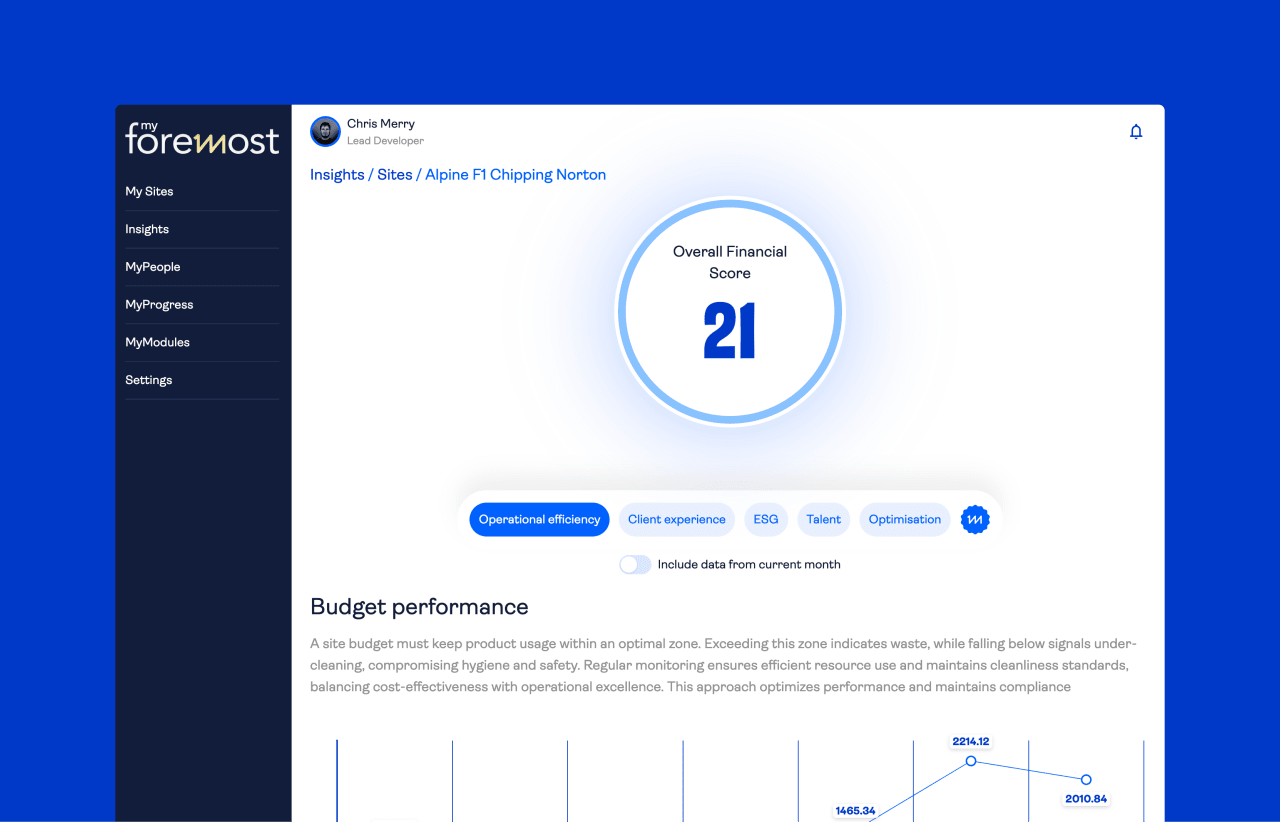 Operational Efficiency at site level. Budget performance is weighted at 60%, consumable trends at 25%, category maximisation at 15%.
How do you make four pillars one product?
The Four Pillars sit at the heart of Quantum: Operational Efficiency, Client Experience, ESG, Talent. Each one aggregates data from a different corner of the business, scored, weighted, and rolled up to a single site-health number. Each customer chooses how much each pillar matters via sliders. The pillar weights flow through to the Optimisations Engine, so the system recommends what matters to that site, not what matters in general.
The Figma prototypes Foremost commissioned were strong on the individual pages, but the joins between sections were thinner. Three or four closely related surfaces lived in different parts of the IA. So before building, we wrote a discovery doc that pulled them into one cohesive place, with extension points for the future. It also recommended dropping the e-commerce store from V1, since Foremost's existing e-commerce already covered the job.
You came back and said this should actually be merged into one cohesive place that does all of this in a joined-up way, and could be extended to do X, Y, and Z in the future. And it made so much sense.
Lyndon Penson, Development Director, Foremost
Cycle 2, MVP Site Scores and beta launch (10 weeks). Operational Efficiency, Client Experience, and ESG live with real data. A scoring model for ESG that handles missing data and outliers cleanly. An aggregate site-health score across the three pillars. Benchmarking. Budget performance. Consumable trends. Product efficiency ratings. CO2 emissions. Social value. Monthly impact reports and downloadable PDF flight paths. Beta-ready, first live customer rollout.
 ESG at site level. Editable emissions streams for hot water, employee travel, goods delivery, and waste disposal, fed back into the monthly impact report.
How do you ship the human side without faking it?
The Talent pillar was the hardest one. It mixes training compliance, team feel-good NPS, and a per-operative psychometric profile across eight dimensions: work ethic, adaptability, people skills, attention to detail, leadership ambition, learning agility, integrity, and purpose-driven.
We built the eight-dimension onboarding quiz. We built the training platform so Foremost's customers can author their own modules without us in the loop. We added video, with the quiz gated behind full playback so an operative can't skip ahead. The Optimisations Engine shipped in the same cycle: rule-based, prioritised by the site's pillar sliders, with email as the default action so a regional manager hears about a problem before they open the dashboard.
How do two developers ship 30 weeks of B2B SaaS?
This is the question we got asked most.
Two developers and a project manager shipped 30 weeks of work because we leaned hard on AI in the toolchain. Planning agents that helped us turn the spec into Notion tasks. Codegen for the repetitive scaffolding. Agent-driven tests for the surfaces we couldn't manually QA at full scale. Zef and Chris on the build, Gem running delivery. Foremost lived inside our Notion project space as a collaborator. Weekly video updates, ad hoc problem-solving sessions whenever the spec moved.
The Quantum product itself has no LLMs in it. That was deliberate. A continuous-improvement system that tracks pay rates and psychometric scores is the wrong place for a probabilistic generator. The intelligence is statistical: spend forecasting, weighted aggregation across the four pillars, and a rule-based optimisations engine prioritised by site strategy.
Not AI in the box. AI in the build.
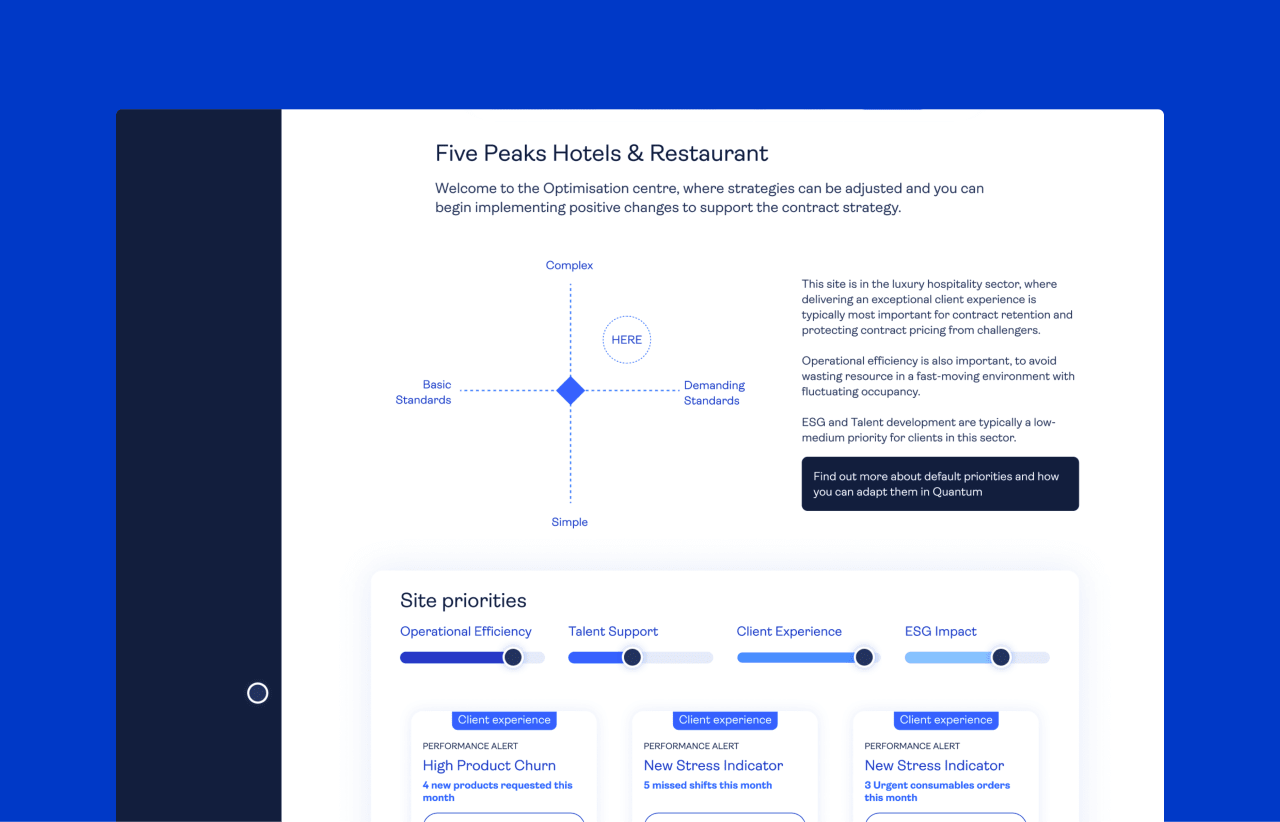 The Optimisations Engine. Rule-based, prioritised by the site's own pillar weights, with email as the default action.
This Quantum software we've launched is completely central to the value we offer our customers. It's our main plank for the best things we do for our best customers.
Lyndon Penson, Development Director, Foremost
What we shipped
Quantum, in production:
- A continuous-improvement system scored across four pillars, with per-site strategy sliders that drive what each customer sees.
- A legacy data sync engine that turns years of transactional history into a live product surface.
- A training platform and onboarding personality quiz that lets Foremost's customers author modules, lock quizzes behind video, and assign training across roles and sectors.
- An Optimisations Engine that generates monthly improvement suggestions, prioritised by the site's own pillar weights, with email as the default action.
- An audit log architected for ISO 27001, ISO 27701, and CSA STAR, capturing every score, budget, role, and optimisation event with the strategy and weights at the time.
 Roles and permissions are configurable per customer and per site, so a cleaning company can tune what an Area Manager can do without us touching the code.
Two developers. One project manager. Three cycles. Six, ten, and fourteen weeks. Zero LLMs in the product, plenty in the build.
What's next
Quantum is rolling out gradually across Foremost's customer base. The architecture was designed for the V2 surfaces already on the roadmap: a re-integrated e-commerce store under the same login, end-client logins with separately configurable visibility, paid-subscription tiers, and two-way integrations into the systems Foremost's customers already use (Fourth, TeamSoftware, Sage, Xero, Bigchange). Every URL pattern, every permission template, every database table was chosen with one of those V2 surfaces in mind.
A trade-show idea is now a live product, with its second decade of customers' worth of data finally pointing somewhere useful.