How a free SEO checker started surfacing potential leads, and the human-reviewed Glitch workflow we built around it.
I thought we were doing an SEO task. We ended up building a little lead-generation workflow with Glitch, our AI agent, in the middle of it.
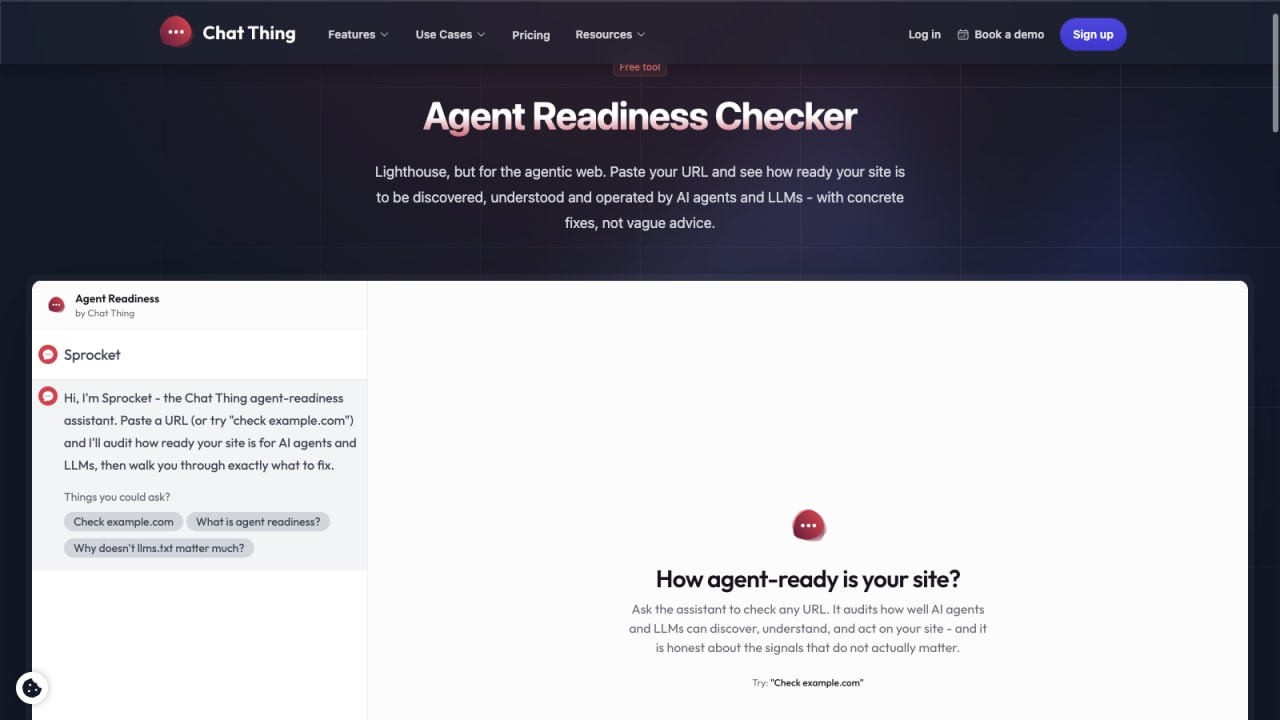
The checker in action, followed by the research and human-review workflow.
We had created a collection of free tools for Chat Thing because they answered questions our potential customers were already searching for. The idea was pretty simple: make something useful, help the right people find us and, hopefully, improve our search visibility at the same time.
One of them was our Agent Readiness Checker. You enter your website and it checks whether AI crawlers and agents can access it, whether the content is structured well enough to be cited, and whether an agent can actually do anything useful there.
The public Agent Readiness Checker. It checks whether AI agents can access, understand and act on a website.
Then people started using it, and I realised the tool was telling us something we had not planned for.
The people checking their websites often had a lot of the traits of our ideal customers. They were already interested in AI, but they were not just reading another article about it. They were actively asking whether their own business was ready for AI agents.
If their website was not ready, that could be something Pixelhop helped them fix. If it was ready, Chat Thing could still be a useful next step. Either way, using the checker was a much stronger signal than somebody simply visiting our website.
That got my attention. The SEO tool had quietly become a potential source of leads, but spotting the signal was only the first part. We still needed to work out who each business was, whether we could help and whether contacting them would be useful rather than annoying.
So we gave the repetitive bit to Glitch
Glitch is the name of the AI agent we use as part of our team. It runs on Hermes Agent, which lets it work across the tools and systems we choose to connect to it. We give Glitch scheduled jobs that might involve researching public sources and bringing the useful parts back to us in Slack. Different AI models can handle different tasks behind the scenes, but we brief and work with Glitch throughout.
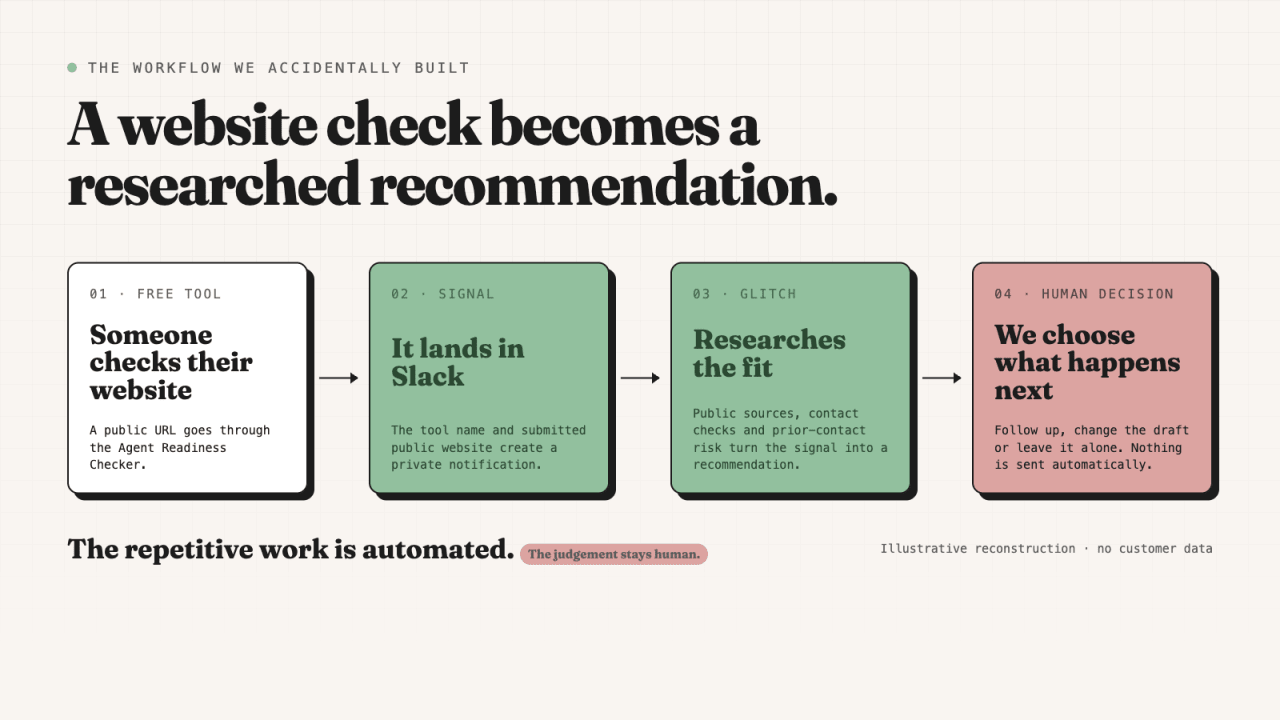
When somebody runs the Agent Readiness Checker, the tool name and the public website they submitted are posted into a private Slack channel.
Every morning, Glitch reviews any new entries. It researches the business using public sources, works out whether Chat Thing, Pixelhop or neither looks like the better fit, finds a verified public business contact where one exists, and checks that we are not already speaking to them through our inboxes or CRM.
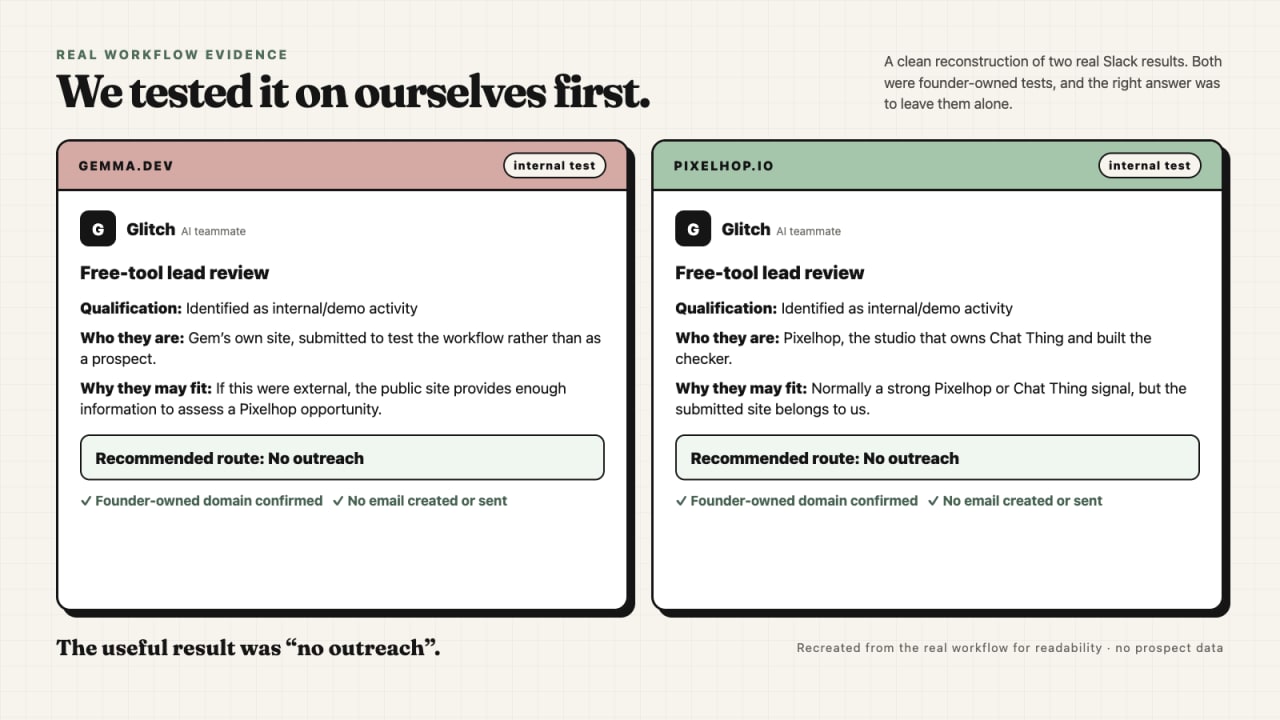
We tested the workflow using Gemma.dev and Pixelhop.io. This reconstruction of the real Slack results keeps the text readable while leaving out private workspace details.
If the business looks relevant, Glitch adds the research, sources and recommendation to the original Slack thread. We make the final decision about whether it is worth following up. If we approve it, Glitch can prepare a short outreach draft, but nothing is sent automatically.
The bit I like most is that the automation is allowed to come back with nothing. It can decide there is not enough information, the company is not a good fit or we have already contacted them. We have not built another machine that sends a generic sales sequence to everyone who moves.
It does the slow research work and gives us a useful recommendation, but the judgement stays with us.
The workflow we built around the tool. This is an illustrative reconstruction using no customer data.
What we built from the signal
We now have a repeatable way to spot businesses that might be a strong fit and assess them without spending part of every day researching each one from scratch. A website check becomes a Slack notification, Glitch turns that into a researched recommendation, and only the worthwhile opportunities make it as far as a human-reviewed outreach draft.
This is the kind of AI automation I find exciting. It is not a big shiny system looking for a problem. It started with something we were already doing, found an unexpected signal inside it and removed a repetitive job without removing the human decision.
We set out to build something useful for SEO. We accidentally built the first step of a much more interesting workflow.
In this blog post, we will pull out some of the design elements and animations and talk about them. We really enjoyed this project because it allowed us to add in many fun things; we added a lot of animations to give that extra special ingredient in our cauldron to make it a potent potion.
In this post we will show you how to transform your body into a skeleton in realtime by analysing a webcam feed with TensorFlow.js and pose detection. For maximum spooky effect we recommend following this tutorial in the dead of night on 31st October.
We loved Notion, until the agent era made it feel too slow, closed, and awkward to work with. Treehouse is our attempt to keep the polish of Notion, combine it with the freedom of Dropbox, and make a workspace that humans and AI agents can share properly.