What it really costs to build and run an AI product, agent or automation in 2026, using our actual prices, real projects and today's model pricing.
Search "how much does AI development cost" and you'll get a lot of pages telling you somewhere between $10,000 and $500,000. That's true in the way "a house costs between £50,000 and £50 million" is true. It doesn't help you decide whether to pick up the phone.
So here are our actual numbers. Most AI products, agents and automations we build fit into one six-week cycle at £27,000 + VAT. Smaller jobs are charged at our day rate of £650 + VAT, even if it's only a couple of days. If you're not sure what you need yet, a discovery week is £3,250 + VAT and ends with a fixed-price proposal.
Running costs are the part that surprises people, usually in a good way. For most of the systems we build, the model bill is tens of pounds a month, sometimes less. It can also be a hundred times that for exactly the same workload if you pick the wrong model, and I'll show you the maths for both.
Everything below uses prices I checked on 16 October 2026. Model prices move fast (two of Google's are going up in the next three months), so if you're reading this much later, check the links.
The short answer
| What you need |
Typical size |
What it costs with us |
| A small automation, or an AI feature added to something you already have |
A few days to a couple of weeks |
£650 + VAT a day |
| Help working out what to build |
One discovery week |
£3,250 + VAT, ending in a fixed-price proposal |
| An AI agent, an automation pipeline or an MVP |
One six-week cycle |
£27,000 + VAT |
| A bigger product |
Two or three cycles |
Quoted as a fixed price per cycle |
| Support and improvements after launch |
Monthly retainer |
£600 a month (1 day), £1,700 (3 days) or £2,700 (5 days) |
Model, API and hosting costs are billed separately. We show them on a cost dashboard from day one, so nobody finds out what the system costs to run from an invoice.
Most of the other guides you'll find are written by large agencies quoting for enterprise teams, and their numbers make sense for that world. In 2024, Gartner put upfront costs for the bigger enterprise generative AI approaches at $5 million to $20 million. If you're a founder or a 20-person business, that's not your price list.
What that looks like on real projects
Ranges are easy to publish, so here's what three actual projects took.
HeyYou
HeyYou had a working AI prototype that could spot a person on a security camera and talk to them through a speaker. They needed a product they could sell. We turned it into a multi-tenant SaaS platform with Axis camera integration, an operator dashboard, subscription billing and a real-time pipeline that goes from camera event to spoken warning in about seven seconds. That was one cycle of build plus two weeks of polish, so eight weeks in total, where most agencies would have scoped six months. The case study has the details.

Orbit
Orbit is an AI grant-scraping pipeline we built for Grants Online. Three agents scrape, categorise and risk-check around 3,000 grants, and 93% of updates now publish without a human touching them. The first production release took four weeks from kickoff. The wider platform it feeds is scoped as two cycles. Here's how Orbit works.

Chat Thing
Chat Thing is our own AI agent product, so we were the client. The first prototype took under a week, and we had a paying customer within a month. That story is here. It's also why I trust the running-cost numbers further down, because we pay them every month.
A cycle with us is a small senior team, often one or two developers working with coding agents. That matters for price. Most of HeyYou was built by one developer working alongside coding agents, on a project originally scoped for two people. The cost of building software has dropped a lot in the last eighteen months, and I'd be suspicious of any quote that hasn't caught up.
Why the price goes up
The model calls are rarely what makes an AI product expensive. When I estimate a project, they're often the quickest bit. The time goes on everything around them.
Plugging into what you already have
HeyYou's AI pipeline was proven before we started. The eight weeks went on multi-tenancy, billing, finding cameras on local networks and all the other things that turn a demo into a product. On larger builds, the unglamorous plumbing (logins, syncing with an old database, migrating data, switching over from the old system) is the part that compresses least, however good the tooling gets.
How right it has to be
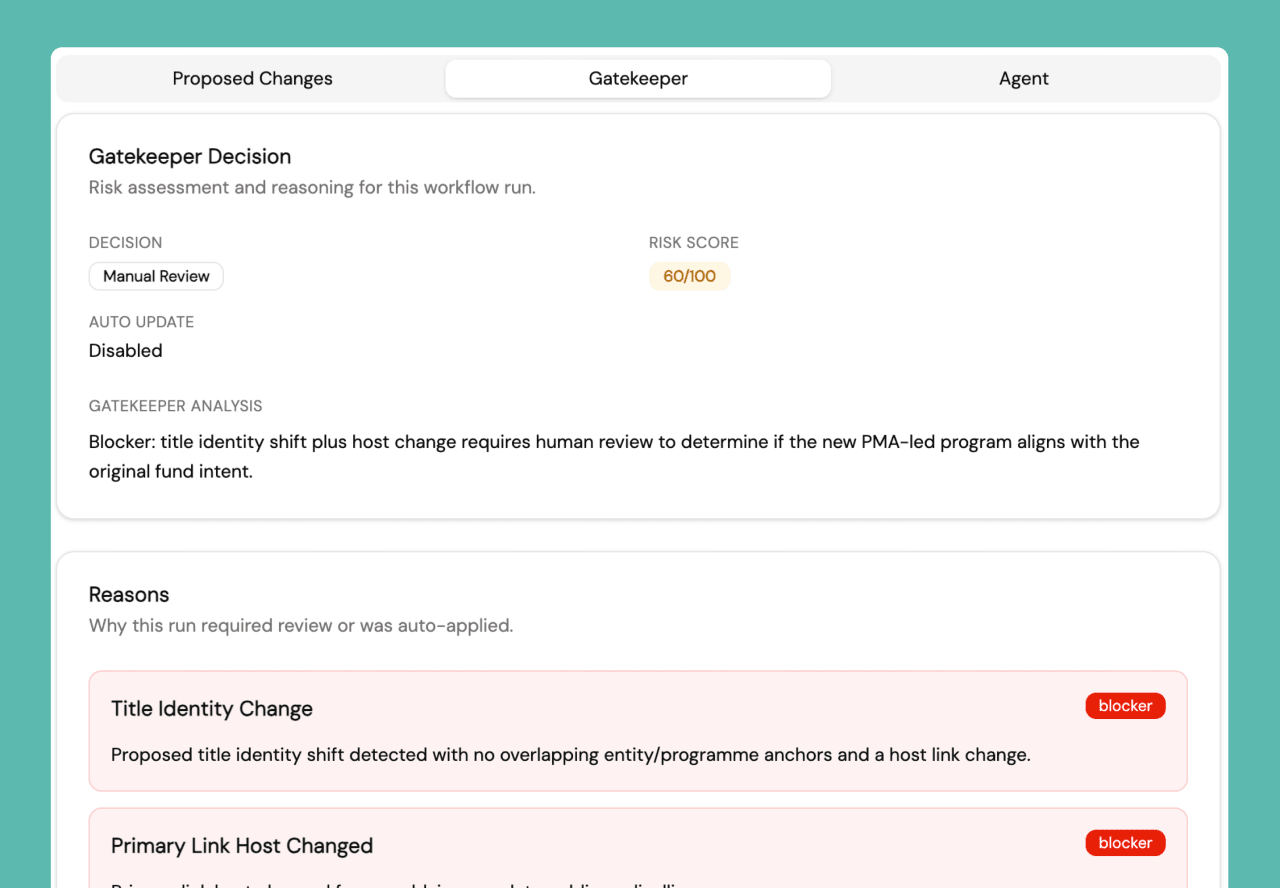
An internal tool that drafts something for a person to check is cheap. A system that publishes changes on its own needs a way to decide when that's safe. On Orbit, a separate Gatekeeper agent scores every change and sends the risky ones to a person. We started strict and loosened it as the agents earned trust. A lot of the value is in that design work, and it takes time.
Testing it properly
You can't unit test your way to confidence with a language model. We build automated evaluations so every change is measured against real examples, plus guardrails on the things that must never go wrong. It's a real line item. Gartner expects over 40% of agentic AI projects to be cancelled by the end of 2027 "due to escalating costs, unclear business value or inadequate risk controls", and weak testing is a direct route to the last of those.
Messy data and more of everything
If the information the AI needs is scattered across PDFs, spreadsheets and someone's inbox, getting it into shape can take longer than the AI work. Two brands, three user types or several languages each add a bit to every feature, too.
What brings it down is an existing prototype, one clear outcome, data that's already in one place, and a team that knows its stack well enough to estimate lean. On Orbit, a rough working demo built in about a day gave us a solid anchor for the rest of the estimate.
What it costs to run
Running costs depend on usage, so here are the sums for a realistic workload.
You pay model providers per token, which is roughly three-quarters of a word. Every call to a model sends input (your instructions, any documents you've pulled in, the conversation so far) and gets output back. Input is cheap, output costs more, and the model you pick changes everything.
Here's what a selection of current models cost per million tokens, from the providers' own pricing pages on 16 October 2026:
| Model |
Input |
Output |
| OpenAI gpt-6-luna |
$0.10 |
$0.50 |
| Claude Haiku 5.5 |
$0.10 |
$0.50 |
| Gemini 3.8 Flash |
$0.75 |
$3.75 |
| Claude Sonnet 5.5 |
$2 |
$10 |
| OpenAI gpt-6.1-sol |
$2 |
$10 |
| Claude Opus 5.5 |
$4 |
$20 |
| Claude Fable 5.1 |
$10 |
$50 |
| OpenAI gpt-6-astra |
$10 |
$50 |
Sources: Anthropic, OpenAI, Google. Google has announced rises: Gemini 3.8 Flash doubles to $1.50 / $7.50 from 1 January 2027, and Gemini 4 Argon goes from $2 / $10 to $4 / $20 from 1 December 2026.
Now a worked example. Say you have a customer support agent handling 1,000 conversations a month. Each conversation makes about five model calls, and each call sends about 5,000 tokens and gets 200 back. Those per-call figures are in line with what we measure across Chat Thing, where production calls average roughly 3,000 to 6,000 input tokens and 50 to 270 output tokens.
That's 25 million input tokens and 1 million output tokens a month. On each model, at about $1.325 to the pound:

| Model |
Monthly model bill |
Roughly in pounds |
| gpt-6-luna or Claude Haiku 5.5 |
$3 |
£2 |
| Gemini 3.8 Flash |
$22.50 ($45 from January) |
£17 |
| Claude Sonnet 5.5 or gpt-6.1-sol |
$60 |
£45 |
| Claude Opus 5.5 |
$120 |
£91 |
| Claude Fable 5.1 or gpt-6-astra |
$300 |
£226 |
That's the same workload with a hundred-fold difference in cost.
For a lot of business tasks the small models are good enough, and where they aren't, you can route the hard steps to a bigger one and keep the rest cheap. Choosing the model for each step is one of the first things we do on a build. Caching helps too. When the same instructions or documents get sent over and over, Claude Sonnet 5.5 bills cache hits at a twentieth of the normal input price. Batch processing, for anything that doesn't need an answer straight away, halves the price on all three providers.
For a real-world reference point, our direct OpenAI invoice for Chat Thing for June 2026 was $397.25, for a product serving paying customers every day. It isn't our whole model bill, because we route other models through OpenRouter, but it gives you a sense of scale.
Then there's the rest of the stack: hosting, a database, somewhere to store search embeddings and a tool to watch what the AI is doing. At small scale, the entry paid tiers are modest. Supabase Pro is $25 a month, Vercel Pro is $20 a seat, Cloudflare Workers is $5, Langfuse for tracing and evaluations is $29 (or free to self-host), and Pinecone's paid vector database starts at $50. You won't need all of them, and some systems need none.
So for a typical small-business agent or automation, running costs land somewhere between tens of pounds and a few hundred pounds a month. At scale they become a real constraint. In McKinsey's 2026 survey, about 20% of respondents said AI operating costs, including token costs, had constrained their AI use.
The bills that catch people out
The scary AI invoices I hear about rarely come from normal use. They tend to come from four places.
- An agent stuck in a loop, retrying a failing step or calling itself again, can make thousands of calls overnight.
- A leaked API key in a public repo or a browser means someone else's usage lands on your account.
- Using a top-tier model for every step, because it was the one in the tutorial, multiplies the bill for no real gain.
- In long conversations, each turn re-sends everything said so far, so every message costs more than the last.
That's why we put a spending cap, rate limits and cost monitoring in before go-live, rather than after the first nasty surprise.
The top models aren't always worth it, either. When we gave Claude Fable 5 a real four-hour build, it did about a month of work almost flawlessly, and the API-equivalent cost was about $476 for that one session. It was brilliant, and probably not something we'd repeat at API prices.

Hiring, contracting or a studio
If you're weighing up building it yourself, here's what the UK market looks like right now. According to IT Jobs Watch, the median UK contract rate for an AI engineer is £600 a day, with the middle half of rates between £500 and £700. The median permanent salary is £87,500, before employer costs, recruitment and the months it can take to find someone good.
Our day rate of £650 sits inside that band. What a cycle adds is design, engineering, evaluation and launch from one team that has shipped this kind of thing before, rather than one person you then need to manage.
Whoever you work with, ask who owns the code, whether your team could run it without them, and what happens when the contract ends. Gartner recently predicted that by 2028, 70% of enterprises will abandon agentic AI built by vendors' forward-deployed engineers, "trapped by soaring costs and unable to evolve it on their own". Settle those questions before you sign anything, with us or anyone else.
Sometimes the answer is not to build at all. If you need a support chatbot trained on your own content, an off-the-shelf product will usually beat a custom build on cost. (Ours, Chat Thing, starts at $49 a month.) Custom work earns its keep when the AI is tangled up in your own processes, data and systems.
Can you get help paying for it?
Possibly, depending on the work. UK companies doing genuine R&D can claim relief under the merged R&D scheme, where the expenditure credit is 20% of qualifying costs (it's taxable, so the net benefit is lower). Wiring an existing model into your software usually won't count as R&D on its own, so speak to an R&D tax adviser before you build it into your budget. Innovate UK also runs AI grant competitions, though the current ones are aimed at AI companies rather than businesses adopting AI.
How to budget if you're not sure yet
You're in good company. Of the UK businesses planning to adopt AI in the government's latest research, 47% had no specific budget and another 25% didn't know theirs.
My advice is to start with the smallest thing that would make a measurable difference, and price that. One workflow automated, one agent answering one kind of question, or one feature that saves your team an afternoon a week. If it works, the next step is easy to justify. If it doesn't, you've found out for the price of a few days or one cycle, not a year-long programme.
If the project is still fuzzy, that's what the discovery week is for. We spend five days with you working out what's worth building, then hand you a fixed-price proposal for the build.
Common questions
How much does it cost to build an AI agent?
With us, most single agents fit in one six-week cycle at £27,000 + VAT, including the integrations, evaluations and monitoring they need to run in production. A narrow agent for one internal task can be a few days' work at our day rate. There's more on our AI agent development page.
How much does an AI app cost to run each month?
For most small-business systems, tens of pounds to a few hundred pounds a month in model and hosting fees. The model you choose can change that by a factor of a hundred, as the worked example above shows.
Are model and API fees included in your price?
No. They're billed separately and visible on the cost dashboard from day one, so you always know what the system costs to run.
How long does it take?
Typically 4 to 12 weeks for a launch-ready MVP. Orbit's first production release took four weeks, and HeyYou took eight.
Is it cheaper to build AI offshore?
Offshore day rates are usually lower. The total depends on how many days the build takes, how much managing it needs and how easy it is to work together across time zones. We're UK-based and UK GDPR compliant, which matters if you handle personal data.
Should we train our own model?
Almost certainly not. Nearly everything we build uses existing models through their APIs, with your data pulled in at the point it's needed. Training a model is a very different budget, and most businesses don't need one.
If you want to talk through what your project would cost, tell us about it. We'll give you a straight answer, even if that answer is to buy something off the shelf. 🐰

